 Photos – Ellis Parrinder
I was chuckling as I walked into the theatre, quietly humming to myself Tom Lehrer’s Oedipus Rex…“who loved his mother”. I was so looking forward to seeing Oedipus Schmoedipus, by the performance art group, post. The publicity promised “every death scene in the most celebrated plays of all time united in one show” and “big laughs, great insight and an outrageous body count”. I envisaged a play full of literary wizardry, outrageous physical comedy and clever insight into how the notion of death has been treated by the theatrical canon. It seemed like a perfect Festival piece. I fondly remembered outrageous liberties that have been taken with the canon – the side splitting humour of Keith Robinson and Tony Taylor’s The Popular Mechanicals (superbly directed by Geoffrey Rush). I imagined the genius of Tom Stoppard delivering another hysterically funny and clever masterpiece like his Rosencrantz and Guildenstern are Dead. I wondered to myself what Kosky and Wright would do with this concept or what insights Wesley Enoch and Deborah Mailman might produce.
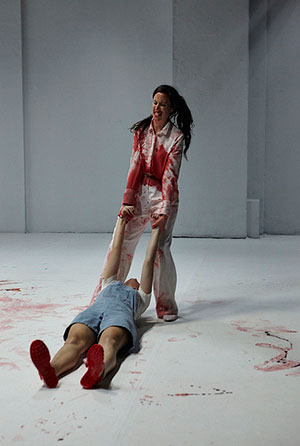
But, one of the rules of going to the theatre is to never second guess the show, and never bring your expectations. In this case we weren’t treated to comic subversions of famous theatrical death scenes. In fact no actual death scenes are played out at any time in the show. Just the moments of death. And some quotes. Oedipus Schmoedipus opens with a 15 minute mash up by actor/writer/directors Mish Grigor and Zoe Coombs Marr of the many ways characters have famously died – shootings, knifings, poisonings, suicides, chopping off hands, cutting out tongues etc – with more spurting blood than in Gail Edwards’ STC production of Coriolanus. This was followed by three stage assistants mopping it all up to music (which reminded me why most big, messy death scenes occur at the end of plays – it takes a very, very long time to clean up a heavily bloodied stage).
By this stage at the Sunday afternoon performance I attended, they had 6 walk outs.
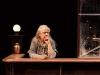
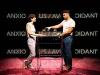
The production is like a cross between a piece of 1980s street theatre and a flash mob. In the first half, Mish Grigor and Zoe Coombs Marr conduct a comic, but prosaic discourse on the notion of what is death. Like some street theatre, it fell into the trap of word-heavy didacticism, based on undeveloped ideas and is heavily reliant on the personal, comic charm of the performers (which all somehow works for street theatre, but doesn’t, in this case, translate to a main stage work). Fortunately Grigor and Coombs Marr have enough charm and stage presence to keep it mostly amusing.
OK, I thought, so we are not going to have some devilishly clever renditions of canonical death scenes, so maybe the show will be about the insight about death that was promised. But in this regard the performers never really rose above stating the obvious and never allowed themselves to explore or substantiate their ideas. It was like watching the two actors deliver an essay that was made up of a number of opening paragraphs, with no development of any thesis.
So what were their insights? Firstly, there are lots of deaths in the canon. This is because it is something that affects us all and so people are naturally fascinated by it and want to understand it. Fair point, not explained, but they moved on quickly.
Another insight was that there are a number of acting clichés that are associated with death scenes and death is regularly compared to sleeping. Here Grigor and Coombs Marr quote a dozen or so references to death as sleep.
A big idea was that the canon was mostly written by dead white men and so it only shows their view of death. That dead white men dominate the canon has been a commonly held idea for a very long time. So long that it has become a little hackneyed as a term. I hoped they might go beyond the cliché and explore the misconceptions behind this world view or compare it to how women writers have depicted death. Or how writers from other, non Anglo-Saxon, cultures depict death. Or how all artistic depictions, across cultures, might differ from the reality of the actual experience. But none of this happened.
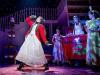
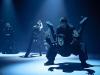
Each night twenty or so new volunteers perform most of the second half of the show. All completely unrehearsed, they read quotes about death from auto cues, dress up in white sheets, wail like ghosts and dance a bit. The volunteers constitute the best idea in the show. It is genuinely exciting to see that many people on the Belvoir stage. They were charming in the same way a stage full of five year olds exude charm at a kindergarten nativity play: all distinctly individual, deeply sincere and all interesting in their own way. And when they danced, it was a bit like watching a flash mob at a railway station – quite good fun. In fact, it is the volunteers who conveyed the most effective and serious moment of the play as each of them, in turn, confirmed that they will all, inevitably, die.
This production of Oedipus Schmoedipus seems like such a missed opportunity to mine a depth of theatrical and philosophical material. It sounded like an interesting concept that promised to be both hilarious and insightful. In fact, to have been either hilarious or insightful probably would have been enough but unfortunately this production doesn’t deliver either.
A Belvoir & post co-production presented in association with Sydney Festival
Oedipus Schmoedipus
Venue: Belvoir St Theatre | 25 Belvoir St, Surry Hills
Dates: 9 January – 2 February 2014
Times: Tuesday 6.30pm | Wednesday to Friday 8pm | Saturday 4pm & 8pm | Sunday 5pm
Tickets: Full $68 | Seniors/Industry/Group $58 | Concession $48 | Previews $48
Bookings: 02 9699 3444 | belvoir.com.au